Mark Rumbak
Not Without HopeMark Rumbak is the critical-care specialist at Tampa General Hospital who examines Nick Schuyler after Nick’s rescue from the Gulf. His decisive role is interpretive as much as clinical: by reading Nick’s temperature, bruising, confusion, and recovery, Rumbak explains how cold, seawater, exhaustion, and bodily constitution shaped the four men’s different fates. He also gives the disaster an ethical correction, insisting that the deaths of Marquis Cooper, Corey Smith, and Will Bleakley must not be understood as a simple failure of courage or will.
Identity and Clinical Role
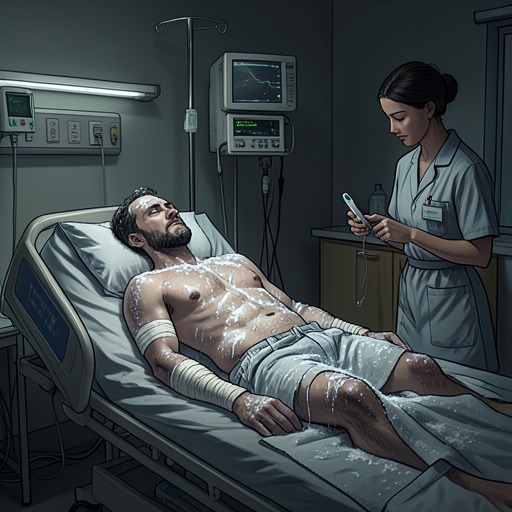
Mark Rumbak appears in the aftermath of the 2009 Clearwater boating accident as the critical-care specialist responsible for examining Nick Schuyler at Tampa General Hospital. When Nick arrives, his temperature has risen to 95 degrees, though he remains somewhat confused. His legs are severely bruised, and doctors are concerned that swelling caused by cold and repeated impacts against the boat might compromise circulation. Rumbak therefore has vascular specialists check the blood supply to Nick’s lower limbs, while the hospital uses compression devices to encourage blood flow and prevent clots.
Rumbak’s observations give medical precision to injuries that Nick’s survival narrative presents through sensation and effort. Nick’s lower limbs are described as one extensive bruise, and his low platelet count adds another clinical concern. The injuries are painful and visually severe, but Rumbak expects the platelet count to return to normal and the bruises to heal. His assessment distinguishes immediate physical damage from permanent catastrophe: Nick is badly injured, but his body is already moving toward recovery.
Explaining Hypothermia and Confusion
Rumbak places Nick’s condition within the physiology of moderate hypothermia. Nick’s temperature when he is found is measured at approximately 88.8 to 89.5 degrees, well below the normal 98.6. Rumbak explains that temperatures in this range can sometimes be deliberately induced in hospitals for patients suffering strokes, acute liver failure, cardiac arrest, or acute brain injury because lowering the body’s temperature decreases metabolism and reduces the need for oxygen. In Nick’s case, however, the same physiological state results from prolonged exposure to cold Gulf water.
His explanation also changes the meaning of the other men’s behavior. Marquis Cooper becomes slow to answer, slurs and rambles, dry-heaves, and chatters constantly after swallowing large amounts of salt water. Corey Smith, after twelve hours in the water, suddenly develops desperate physical energy, attempts to pull himself onto the overturned boat, and appears angry and aggressive before becoming lifeless and trying again. Nick recognizes that neither man is behaving as he normally would. Rumbak supplies the clinical framework: hypothermia can produce delirium, falling potassium levels, and deterioration of the heart’s cell membranes until the heart can no longer contract.
Rumbak therefore rejects the notion that the three dead boaters simply gave up. Their apparent passivity, aggression, slurred speech, and irrational movements are symptoms of bodily collapse rather than deliberate decisions to abandon life. In his account, cold reaches the brain, confusion takes over, and the victims can slip away without possessing a clear understanding of what is happening. The medical explanation does not make the deaths less tragic, but it prevents the survivors’ memories from turning physiological failure into moral blame.
Why Nick Schuyler Survived
Rumbak estimates that Nick could have lived another six to twelve hours in the Gulf when he was found. Nick was not yet at the point of imminent death, and his temperature rose steadily after the crew of the USCGC Tornado removed his wet clothes and wrapped him in wool blankets. Because that rewarming was already working, Tampa General Hospital did not need to inject him with warm fluids.
Yet Rumbak cannot reduce Nick’s survival to one protective factor. Nick has little body fat, which normally leaves a person with less insulation against cold. The same lean athletic build that makes him terrifically fit may therefore have worked against him thermally. Rumbak notes that Nick’s fitness nevertheless gave him an important advantage: professional athletes and similarly trained people are accustomed to pushing through pain and continuing when their bodies resist. Nick’s personal-trainer conditioning and refusal to stop become forms of survival capacity, even though his lack of body fat increases his exposure to heat loss.
Rumbak also considers the practical details of Nick’s conduct. After becoming seasick, Nick puts on a sweatshirt and winter jacket, clothing that may have slowed the loss of heat. His childhood in Ohio, including a habit of wearing shorts in temperatures around 25 degrees, may have given him some acclimatization to cold. None of these factors fully explains the outcome. Rumbak emphasizes that all four men are roughly the same age, size, and level of fitness, yet Nick outlasts the others by a startling margin. The result remains, in his judgment, close to a medical miracle.
Survivor’s Guilt and Moral Interpretation
Rumbak’s most important intervention concerns Nick’s psychological burden. Nick has been forced to release Marquis Cooper when he can no longer hold both Marquis and Corey, telling Marquis that he loves him and promising to protect his family before watching his body drift away. Later, Nick tells Will Bleakley that he will not let him die, but Will is also unable to remain safe on the overturned boat. These scenes leave Nick with the knowledge that he survived while the friends beside him did not.
Rumbak recognizes that survivor’s guilt is real and potentially tormenting, but he argues that Nick has no reason to regard himself as responsible for the deaths. Hypothermia, not a conscious decision by the victims to surrender, accounts for their confusion and physical collapse. Even if Nick had tied them to the boat, Rumbak says, their hearts might have stopped before rescuers found them. The distinction matters because it separates failed rescue from intentional harm: Nick did not kill his friends, did not try to end their lives, and did not choose a situation in which their lives were placed against his.
The diagnosis does not instantly relieve Nick. Rumbak acknowledges that Nick has many demons and may struggle to accept that survival was not a betrayal. His medical language consequently becomes part of the book’s larger moral argument. It preserves the reality of Nick’s love and effort while refusing to make him answerable for biological processes beyond his control.
Narrative Significance
Mark Rumbak stands at the point where the sea ordeal becomes legible to the outside world. Nick’s account records bodies shivering, bleeding, slurring, vomiting, drifting, and fighting for the boat; Rumbak organizes those signs into a sequence involving dehydration, salt-water exposure, hypothermia, delirium, cardiac danger, and rewarming. The Coast Guard’s medical treatment stabilizes Nick, but Rumbak’s interpretation stabilizes the meaning of the event as well.
His testimony also complicates the apparent contradiction between athletic strength and survival. Marquis Cooper is extraordinarily powerful and physically lean, while all four men are fit; strength cannot simply be equated with endurance in cold water. The disaster reveals that survival depends on interacting variables, including insulation, clothing, exposure, confusion, physical exertion, and the ability to keep resisting. Rumbak’s conclusion leaves room for medical probability without pretending that probability fully accounts for Nick’s continued life.
By explaining both Nick’s survival and the others’ deaths without reducing either to character judgment, Rumbak becomes the book’s principal counterweight to survivor’s guilt. His clinical account does not erase grief or absolve the sea of its violence. It does, however, replace the cruel question of why Nick lived when the others died with a more exact understanding of what cold and immersion did to four similar bodies under unequal circumstances.